How I turned a high-value investment product from #3 to the #1 acquisition channel in 8 weeks
How I turned a high-value investment product from #3 to the #1 acquisition channel in 8 weeks
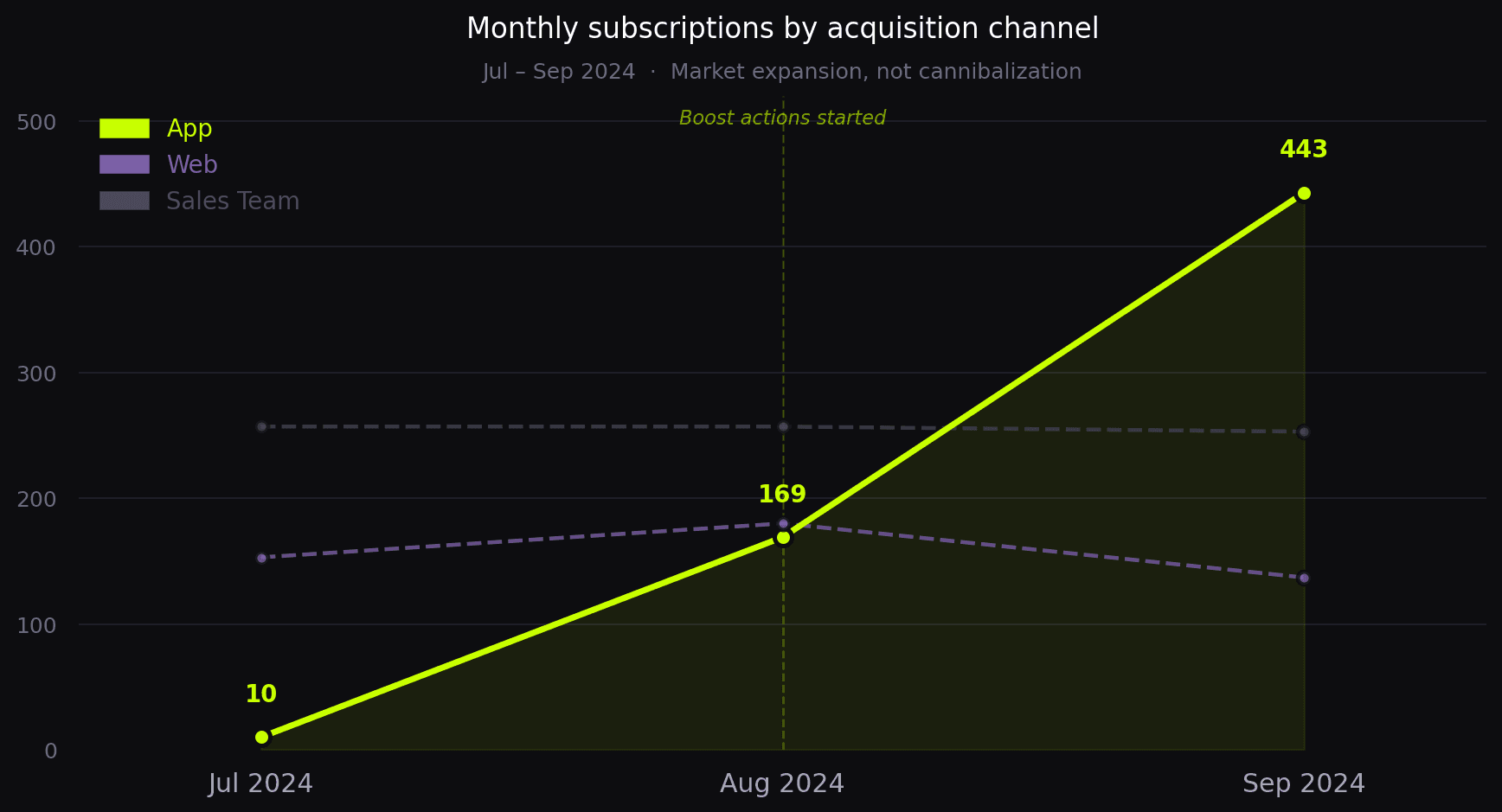
A product with an 85% customer value score, validated by internal research with real users, was generating only 48 subscriptions in its first weeks on mobile, against 145 from the web platform. The product wasn't the problem, discoverability was. In 8 weeks, through behavioral data analysis, cross-squad negotiation, and three targeted design interventions, the mobile channel went from last place to #1 acquisition channel, reaching 443 monthly subscriptions in September, surpassing both the web platform and specialist recommendations, and contributing to nearly R$7M in managed portfolios without cannibalizing existing channels.
A product with an 85% customer value score, validated by internal research with real users, was generating only 48 subscriptions in its first weeks on mobile, against 145 from the web platform. The product wasn't the problem, discoverability was. In 8 weeks, through behavioral data analysis, cross-squad negotiation, and three targeted design interventions, the mobile channel went from last place to #1 acquisition channel, reaching 443 monthly subscriptions in September, surpassing both the web platform and specialist recommendations, and contributing to nearly R$7M in managed portfolios without cannibalizing existing channels.
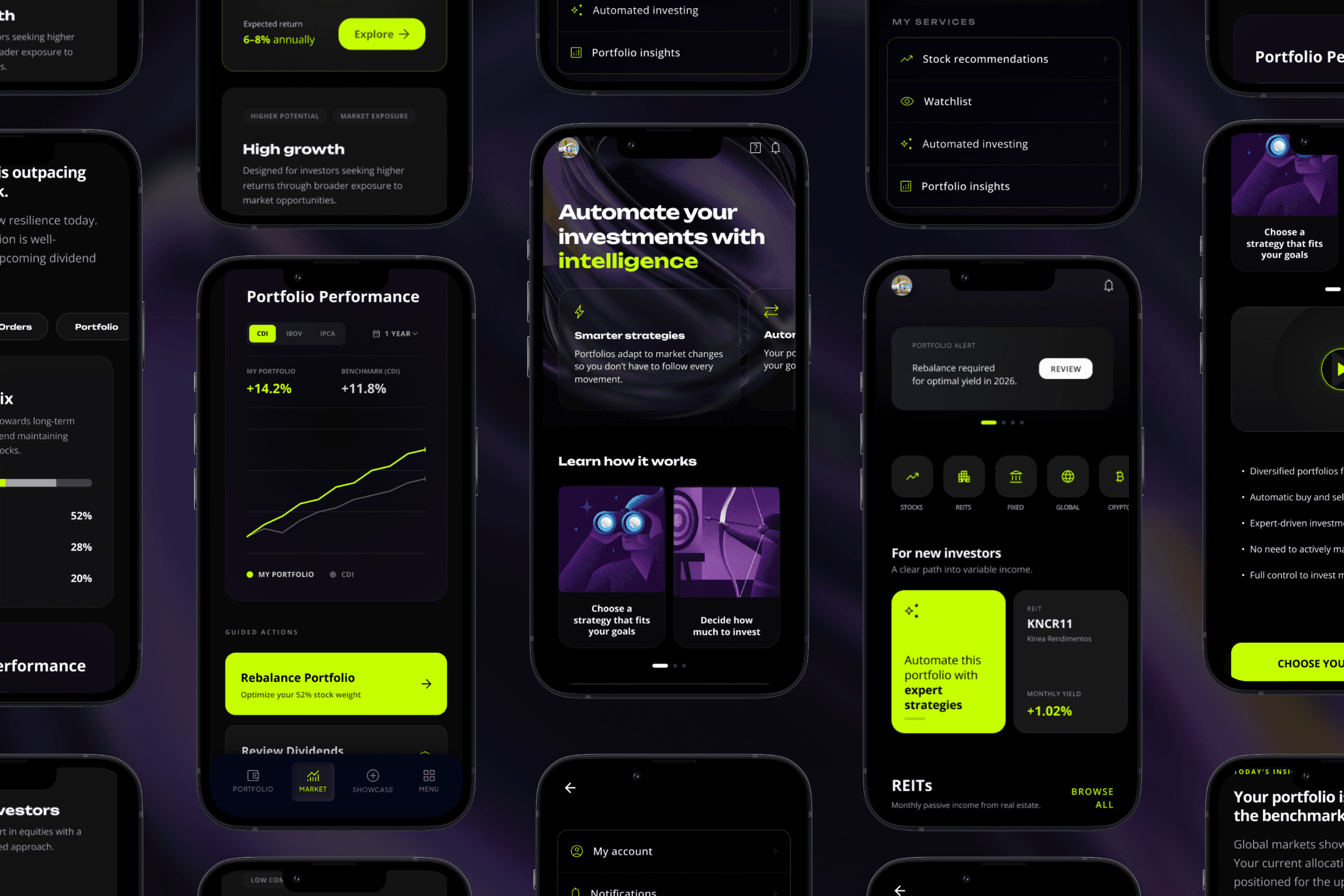
Project Summary
Project Summary
What: Mobile funnel optimization and contextual discovery strategy for an automated investment product
For whom: Retail investors seeking expert-managed, hands-off portfolio solutions
When: July–September 2024 · 8-week sprint
How: Google Analytics deep-dive, cross-squad negotiation, rapid experimentation framework
Why: Strong product-market fit (85% SVM score) with no corresponding acquisition performance, a classic context problem, not a product problem
Project: Automated Investing lets retail investors build diversified stock portfolios managed by specialists, with automatic rebalancing, combining expert curation with automated execution for users who want professional management without the cognitive load of active trading.
What: AI-powered investment mentor with three specialized conversational agents designed to guide beginners through psychological and educational barriers to investing.
For Whom: First-time investors globally struggling with fear, complexity, and lack of trusted guidance, representing 15% of all US investors who started in 2020 alone (Bankrate, 2025).
When: 48-hour rapid prototyping during Alura's AI + Design + Code intensive program.
How: Multi-agent architecture with smart routing, real-time Brazilian market data integration, and anxiety-first conversation design.
Why: To transform the 79% who find investing intimidating (NerdWallet, 2024) by providing fear-reducing, educational guidance that builds autonomous decision-making confidence.
Context & Challenge
Context & Challenge
Before the mobile launch, internal product validation research (SVM — single value metric) tested the product's perceived value with real customers. The result: 85% — "Go!" status, the highest possible tier, exceeding benchmarks across all 11 evaluation criteria including credibility, relevance, and utility. Users highlighted two things above all else: the reliability of expert recommendations and the convenience of automatic rebalancing. The service had clear product-market fit.
When Automated Investing launched on the mobile app in July 2024, the numbers told a different story. In the first three and a half weeks post-launch (the pre-intervention baseline) the app generated only 48 subscriptions, while the web-based platform registered 145 in the same period. The drop-off rate on the first informational screen was 50%. The product shortcut was buried in 7th position within a low-traffic area. ~90% of all investment transactions in the platform happened in variable income (exactly this product's territory) and yet it wasn't being found.
Before the mobile launch, internal product validation research (SVM — single value metric) tested the product's perceived value with real customers. The result: 85% — "Go!" status, the highest possible tier, exceeding benchmarks across all 11 evaluation criteria including credibility, relevance, and utility. Users highlighted two things above all else: the reliability of expert recommendations and the convenience of automatic rebalancing. The service had clear product-market fit.
When Automated Investing launched on the mobile app in July 2024, the numbers told a different story. In the first three and a half weeks post-launch (the pre-intervention baseline) the app generated only 48 subscriptions, while the web-based platform registered 145 in the same period. The drop-off rate on the first informational screen was 50%. The product shortcut was buried in 7th position within a low-traffic area. ~90% of all investment transactions in the platform happened in variable income (exactly this product's territory) and yet it wasn't being found.
The hypothesis was clear: the poor performance wasn't caused by a weak product, it was caused by offering the right product at the wrong moment. Users had investment intent but weren't encountering Automated Investing when they needed it most.
The hypothesis was clear: the poor performance wasn't caused by a weak product, it was caused by offering the right product at the wrong moment. Users had investment intent but weren't encountering Automated Investing when they needed it most.
My Role & Strategic Approach
I was the Lead Product Designer for transactional journeys on the investment squad. This project required going beyond my team's direct ownership, the highest-impact touchpoints were controlled by other squads. The work was as much about organizational influence as interface design.
Team play
Cross-functional with the Variable Income squad, Showcase team, Marketing, and Engineering. All major interventions required negotiation and buy-in from teams I didn't manage.
What I owned
Google Analytics analysis: funnel, click rates, entry points, drop-off
Experimentations and growth strategies
Business case building for cross-squad negotiation
Design and handoff for all three interventions
Weekly performance tracking and leadership reporting
Key findings
Key findings
Using Google Analytics, I mapped the complete subscription funnel and identified three compounding problems, none of which were about product quality.
Using Google Analytics, I mapped the complete subscription funnel and identified three compounding problems, none of which were about product quality.
📍 Buried placement
7th position in the Variable Income section, a high-intent area, but users had to scroll past six other options before ever seeing the product.
🚫 50% abandoned on entry
Half of all users left on the first informational landing page, before seeing a single portfolio or return rate.
⏱ Context mismatch
Users actively researching stocks (with clear investment intent) never encountered the product. The right moment was missing entirely.
Key insight: The SVM showed 85% perceived value. GA showed 50% immediate abandonment. That gap was not about the product, it's about context. Users were leaving because they arrived without the right mindset, or never arrived at all. The solution wasn't to redesign the product. It was to redesign when and where it appeared.
Key insight: The SVM showed 85% perceived value. GA showed 50% immediate abandonment. That gap was not about the product, it's about context. Users were leaving because they arrived without the right mindset, or never arrived at all. The solution wasn't to redesign the product. It was to redesign when and where it appeared.
UX Strategy & Solution Proposal
UX Strategy & Solution Proposal
The strategy wasn't a redesign, it was a series of fast, testable interventions, each designed to intercept users at a higher-intent moment. Before the three main experiments below, we also ran email campaigns and other communications to drive awareness. These generated initial traffic but didn't meaningfully move subscriptions, confirming that the problem wasn't external visibility. It was in-product context and friction. Everything that followed was built on that premise: find where users already have investment intent, and meet them there.
The strategy wasn't a redesign, it was a series of fast, testable interventions, each designed to intercept users at a higher-intent moment. Before the three main experiments below, we also ran email campaigns and other communications to drive awareness. These generated initial traffic but didn't meaningfully move subscriptions, confirming that the problem wasn't external visibility. It was in-product context and friction. Everything that followed was built on that premise: find where users already have investment intent, and meet them there.
Disclaimer: The following visuals were designed by me and serve solely as illustrative mockups. They do not represent actual screens from the company’s internal products or user interfaces. For confidentiality reasons, all visuals have been recreated to simulate the original design logic without exposing proprietary information.
Disclaimer: The following visuals were designed by me and serve solely as illustrative mockups. They do not represent actual screens from the company’s internal products or user interfaces. For confidentiality reasons, all visuals have been recreated to simulate the original design logic without exposing proprietary information.
A contextual trigger inside the showcase
The previous two interventions improved an existing funnel. This one created a new one. Users browsing individual stock recommendations were the most high-intent investors in the app, already researching, already engaged, already in decision-making mode.
Through negotiation with the Showcase squad I designed a contextual card within the stock recommendation flow: not a competing product, but a natural next step. "You're already interested in these stocks, here's a way to invest in them automatically, managed by specialists."
+305%
Weekly subscriptions
+76%
Of all app subscriptions
originated from this trigger
Removing the landing page
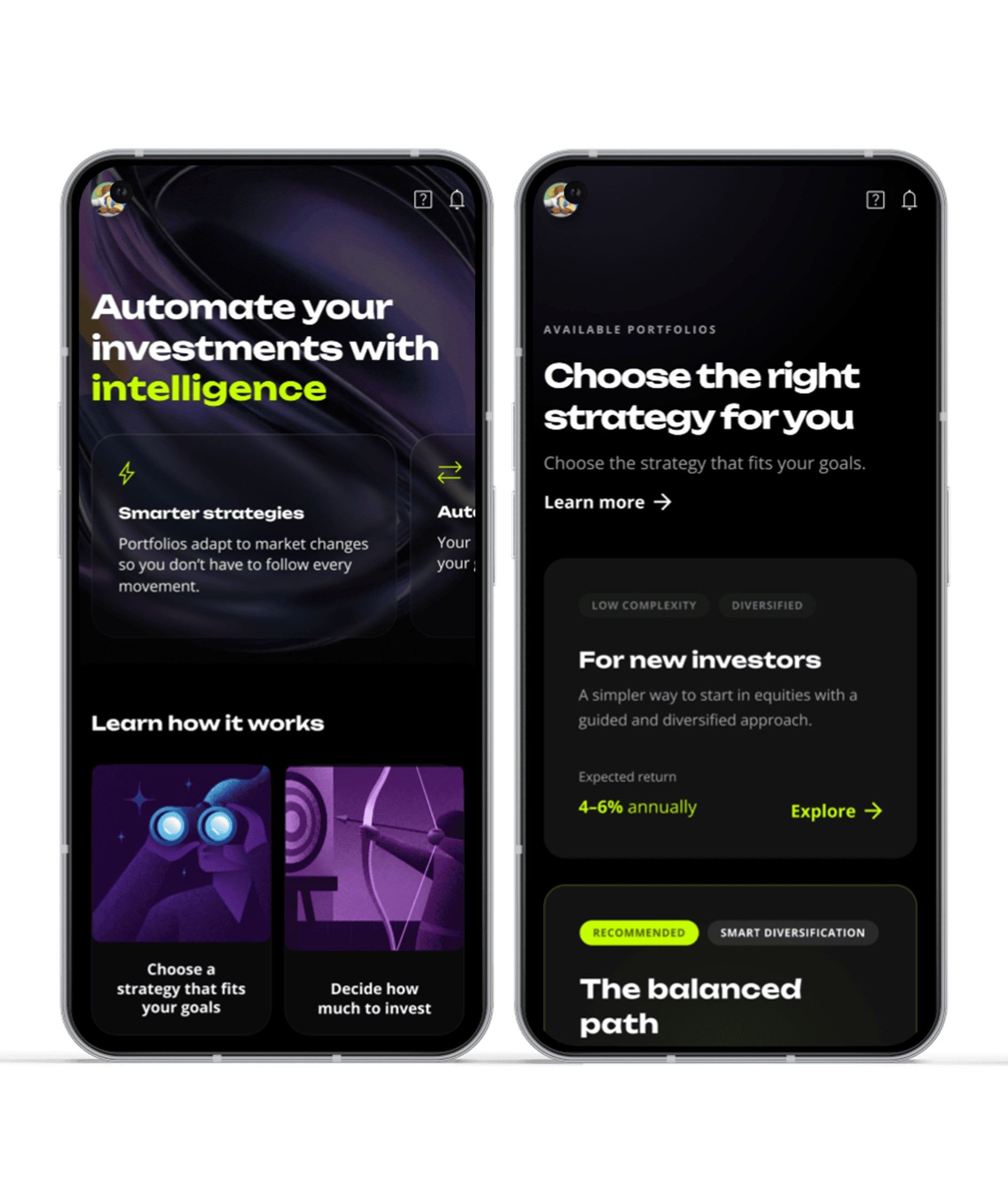
The informational landing page was causing 50% of users to abandon before reaching a single portfolio. The previous flow required everyone to pass through it, regardless of whether they needed it.
The fix was simple. I moved that information into a "Learn more" action inside the portfolio selection screen, where the product's value was already visible. Users who wanted more context could still get it. Users who were ready to decide didn't have to sit through content they didn't need.
The result: routing users directly to portfolio selection, with performance data visible on arrival, increased the share of users reaching portfolio details.
+248%
Users reaching
portfolio details
+262%
Weekly
subscriptions
Repositioning the shortcut
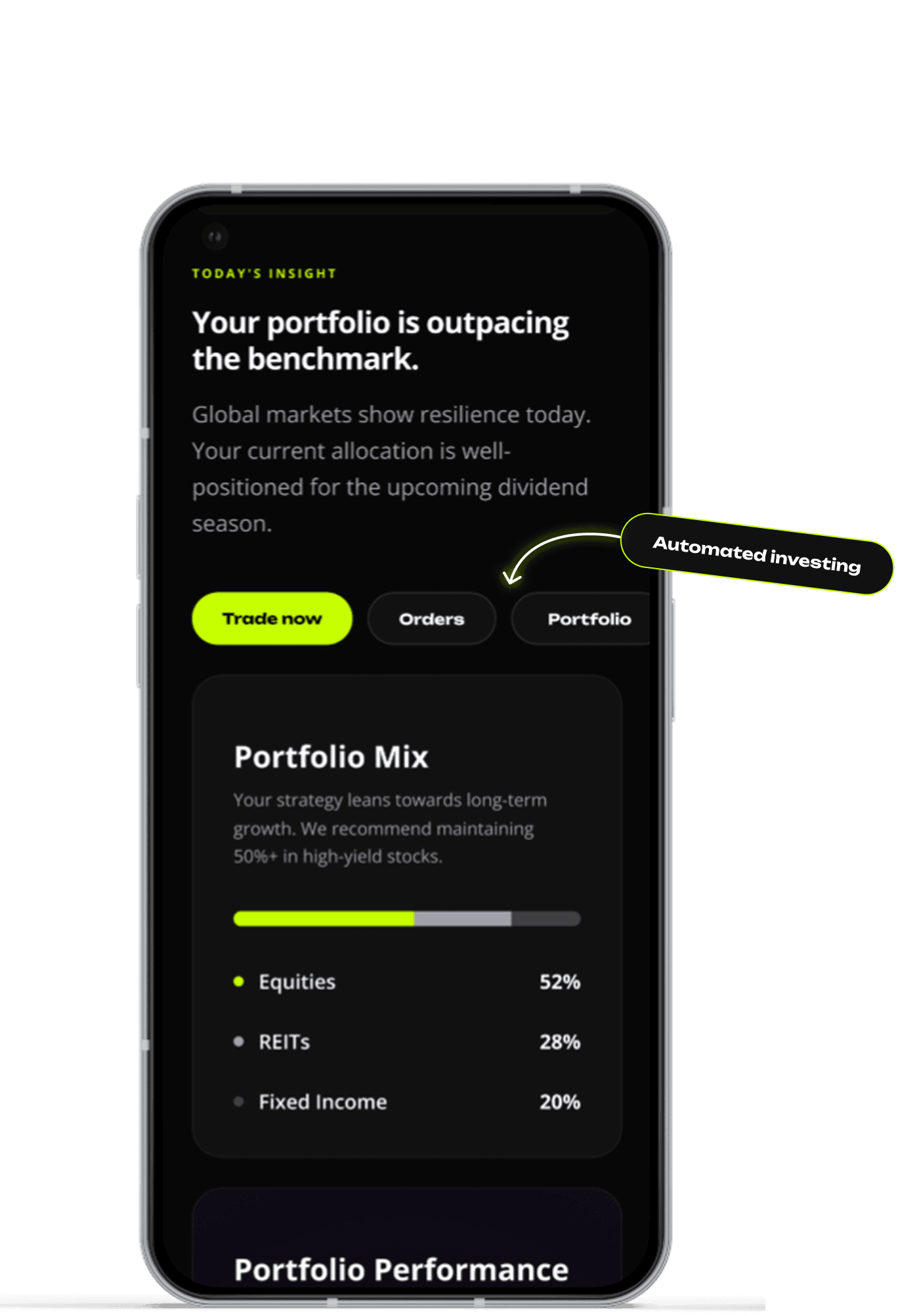
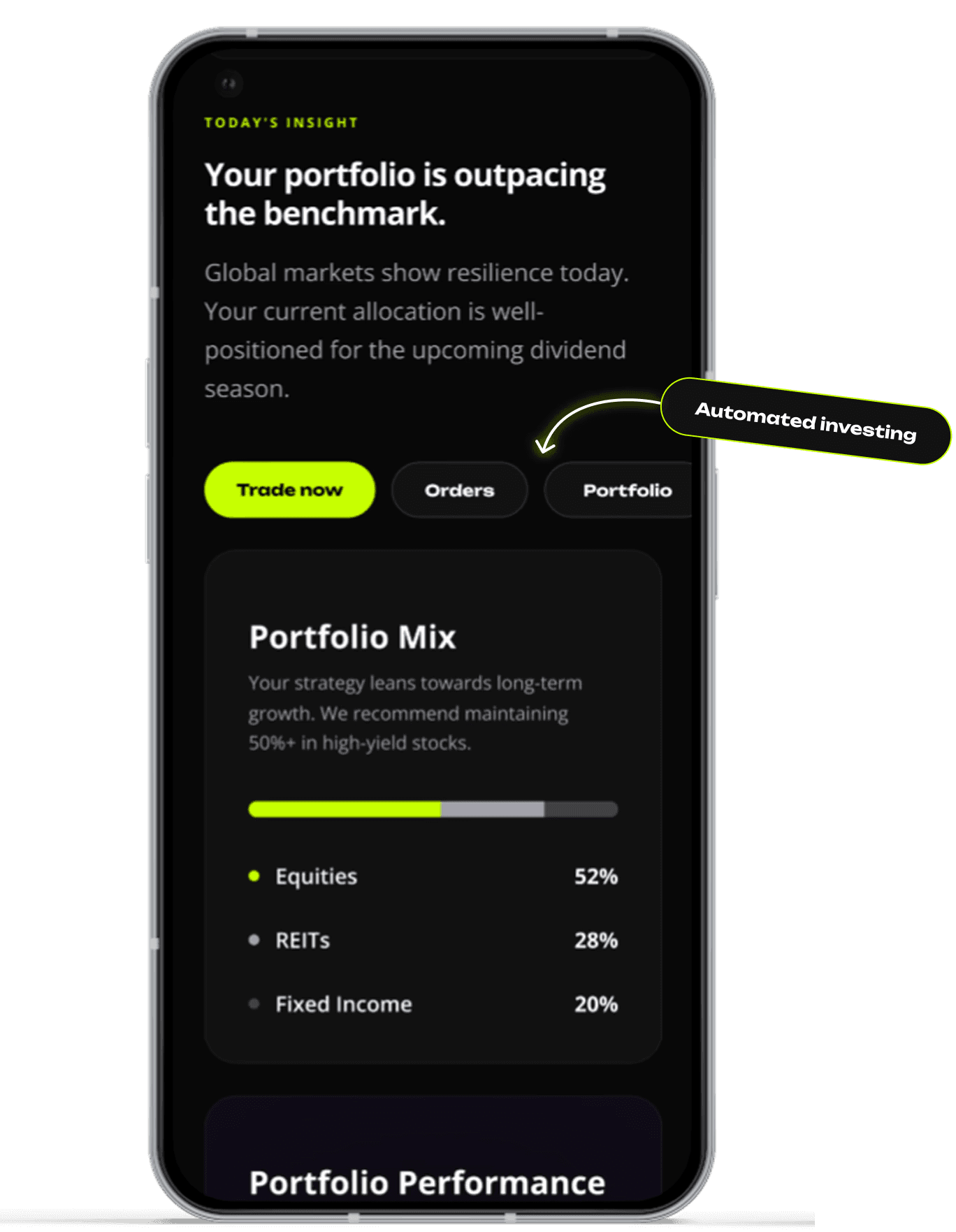
The Variable Income section had consistently high traffic from active investors, exactly the right audience. But Automated Investing was in 7th position, below the fold, invisible in practice.
I built a business case for the Variable Income squad to move the shortcut to 3rd position and updated the deep link to route directly to available portfolios, skipping the generic landing page.
+130%
Traffic increase
7x
More subscriptions
Impacts & Results
Impacts & Results
Quantified growth metrics:
Mobile optimization impact: August → September 160%+ growth in monthly subscriptions
Channel transformation: 8-week sprint from optimization start to market leadership
Competitive achievement: Mobile app surpassed both Home Broker and specialist recommendation channels
Market leadership: Mobile became majority market share holder, outperforming established channels
Market Expansion, not Cannibalization: Critical analysis revealed that mobile growth represented genuine market expansion rather than redistribution. Tracking performance across all channels during optimization period:
August vs September performance:
Mobile app: Substantial growth while other channels remained stable
Specialist recommendations: Maintained consistent performance (~250 subscriptions)
Home Broker: Maintained consistent performance (~170 subscriptions)
Total market grew by over 100% during optimization period, proving the intervention unlocked latent demand. This indicates successful identification and capture of underserved user segments who previously weren't engaging with any acquisition channel.
In August 2024, the app contributed to nearly R$7M in portfolio subscriptions across 475 total contracts. The showcase trigger originated 76% of those app contracts, making it the single highest-converting touchpoint across the entire product ecosystem.
Quantified growth metrics:
Mobile optimization impact: August → September 160%+ growth in monthly subscriptions
Channel transformation: 8-week sprint from optimization start to market leadership
Competitive achievement: Mobile app surpassed both Home Broker and specialist recommendation channels
Market leadership: Mobile became majority market share holder, outperforming established channels
Market Expansion, not Cannibalization: Critical analysis revealed that mobile growth represented genuine market expansion rather than redistribution. Tracking performance across all channels during optimization period:
August vs September performance:
Mobile app: Substantial growth while other channels remained stable
Specialist recommendations: Maintained consistent performance (~250 subscriptions)
Home Broker: Maintained consistent performance (~170 subscriptions)
Total market grew by over 100% during optimization period, proving the intervention unlocked latent demand. This indicates successful identification and capture of underserved user segments who previously weren't engaging with any acquisition channel.
In August 2024, the app contributed to nearly R$7M in portfolio subscriptions across 475 total contracts. The showcase trigger originated 76% of those app contracts, making it the single highest-converting touchpoint across the entire product ecosystem.
What I learned
→ The best product is invisible if it appears at the wrong moment
Discovery and context are product design decisions, not marketing afterthoughts.
→ Influence is a design skill
None of the three interventions happened on surfaces my squad owned. The most impactful work I did was the business cases that convinced other squads to give us space in their flows.
→ Context beats visibility
Moving from 7th to 3rd in navigation helped. But the showcase trigger (finding users in a completely different mindset) drove 76% of all subscriptions. Where a user is in their journey matters more than where your product sits in a menu.
→ The best product is invisible if it appears at the wrong moment
Discovery and context are product design decisions, not marketing afterthoughts.
→ Influence is a design skill
None of the three interventions happened on surfaces my squad owned. The most impactful work I did was the business cases that convinced other squads to give us space in their flows.
→ Context beats visibility
Moving from 7th to 3rd in navigation helped. But the showcase trigger (finding users in a completely different mindset) drove 76% of all subscriptions. Where a user is in their journey matters more than where your product sits in a menu.
Note on confidentiality: Due to the strategic nature of this project, all metrics have been rounded to protect sensitive business information. Visual materials have been recreated to demonstrate design logic without exposing proprietary interfaces or internal systems.
Note on confidentiality: Due to the strategic nature of this project, all metrics have been rounded to protect sensitive business information. Visual materials have been recreated to demonstrate design logic without exposing proprietary interfaces or internal systems.
Let's work together
Open to the right remote opportunities. If you're building something complex and need a designer who can hold the full picture, let's talk.

Let's work together
I'm currently open to remote design opportunities, whether freelance, contract, or full-time. I help teams build high-impact digital products through a mix of strategy, design, and user research, with a strong focus on usability, clarity, and business alignment.
Ready to explore a project together?
Team play
Cross-functional with the Variable Income squad, Showcase team, Marketing, and Engineering. All major interventions required negotiation and buy-in from teams I didn't manage.
What I owned
→ Google Analytics analysis: funnel, click rates, entry points, drop-off
→ Experiment strategy and effort vs. impact prioritization
→ Business case building for cross-squad negotiation
→ Design and handoff for all three interventions
→ Weekly performance tracking and leadership reporting