Designing a crypto experience for young investors in a traditional bank
Designing a crypto experience for young investors in a traditional bank
In 2023, many clients (especially in Montevideo) were already using their cards to buy crypto elsewhere, but felt exposed to scams, legal doubts, and complex UIs. I led the end-to-end product design of OCA’s first integrated crypto wallet to bring Bitcoin and Ethereum into the OCA Blue account experience.
Through research with 58 participants, I learned that 80% had heard of crypto but had never transacted, so the real barrier wasn’t access, it was trust and education at decision points. Based on that insight, I designed an education-first journey with contextual guidance and safety cues to help beginners act with confidence.
In usability testing, the flow reached 100% task completion and 4.8/5 satisfaction. The MVP earned executive approval and positioned OCA as Uruguay’s first traditional bank to offer integrated crypto services.
In 2023, many clients (especially in Montevideo) were already using their cards to buy crypto elsewhere, but felt exposed to scams, legal doubts, and complex UIs. I led the end-to-end product design of OCA’s first integrated crypto wallet to bring Bitcoin and Ethereum into the OCA Blue account experience.
Through research with 58 participants, I learned that 80% had heard of crypto but had never transacted, so the real barrier wasn’t access, it was trust and education at decision points. Based on that insight, I designed an education-first journey with contextual guidance and safety cues to help beginners act with confidence.
In usability testing, the flow reached 100% task completion and 4.8/5 satisfaction. The MVP earned executive approval and positioned OCA as Uruguay’s first traditional bank to offer integrated crypto services.
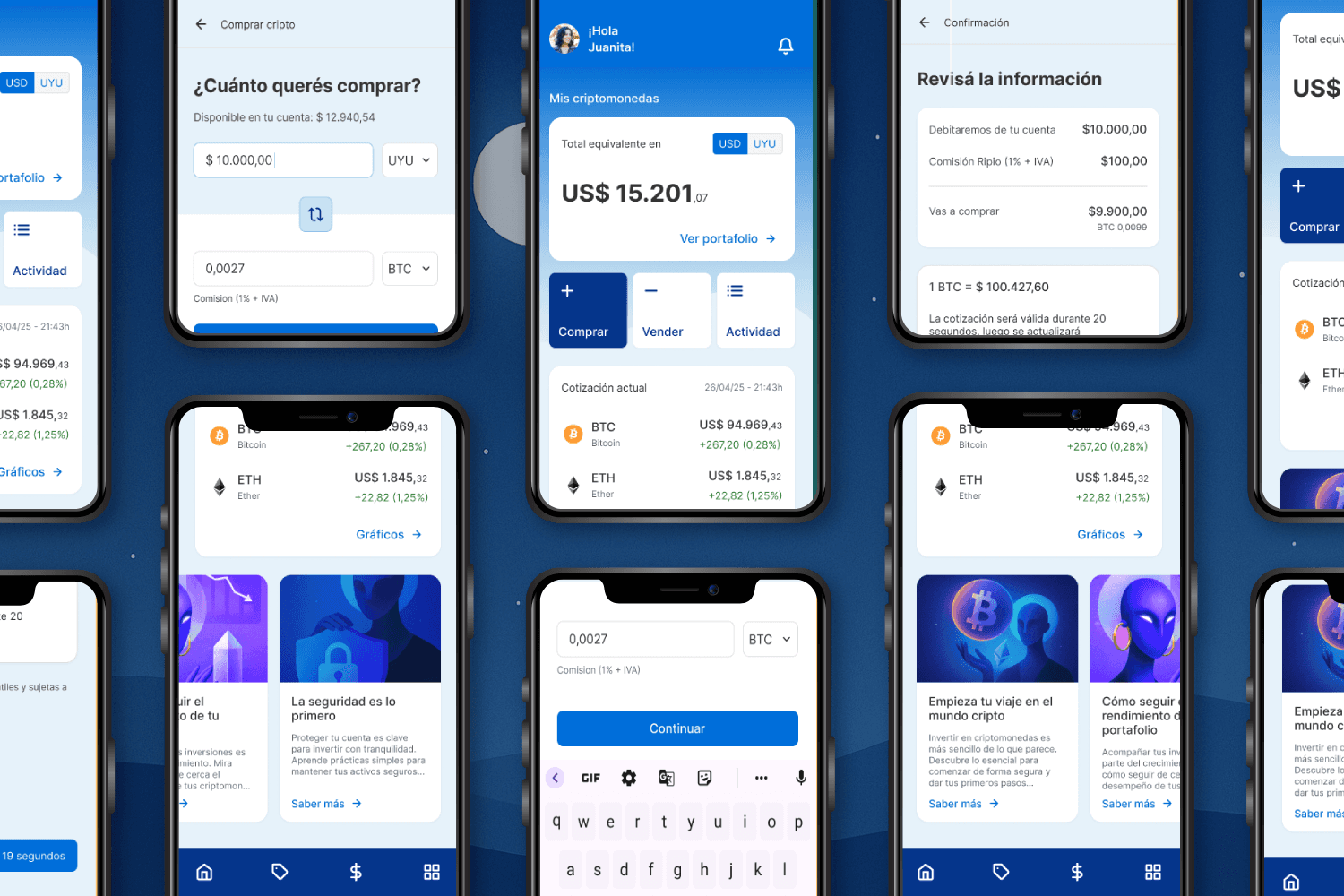
Context & Challenge
Context & Challenge
When we started, OCA was in a paradoxical position: card analytics showed customers were already using their OCA cards to buy crypto on external platforms, but the bank itself had no crypto offering. In Uruguay, where OCA is a long-standing, trusted brand, this meant young, digitally savvy clients were taking their riskiest financial behavior outside the bank’s ecosystem.
The question wasn’t just “how do we launch crypto?”, but “how do we bring crypto into a regulated bank in a way that feels safe, simple and worth trusting?”
Business goals
Capture emerging market share in the growing crypto space
Retain and attract younger customers (25–40 years old)
Leverage OCA’s reputation as a regulated, traditional institution
Differentiate from crypto-native apps through education and security
When we started, OCA was in a paradoxical position: card analytics showed customers were already using their OCA cards to buy crypto on external platforms, but the bank itself had no crypto offering. In Uruguay, where OCA is a long-standing, trusted brand, this meant young, digitally savvy clients were taking their riskiest financial behavior outside the bank’s ecosystem.
The question wasn’t just “how do we launch crypto?”, but “how do we bring crypto into a regulated bank in a way that feels safe, simple and worth trusting?”
Business goals
Capture emerging market share in the growing crypto space
Retain and attract younger customers (25–40 years old)
Leverage OCA’s reputation as a regulated, traditional institution
Differentiate from crypto-native apps through education and security
Stakeholders had a clear ambition: “enter the crypto market”, but limited alignment on who this product should serve, which problems to solve first and how OCA should position itself against existing players. The discovery phase became crucial not only to define what to build, but to sharpen the target audience, risk appetite and product strategy behind this first crypto move.
Stakeholders had a clear ambition: “enter the crypto market”, but limited alignment on who this product should serve, which problems to solve first and how OCA should position itself against existing players. The discovery phase became crucial not only to define what to build, but to sharpen the target audience, risk appetite and product strategy behind this first crypto move.
My Role & Setup
My Role & Setup
I was the sole Product Designer on this initiative, working with cross-border teams in Brazil and Uruguay and validating the MVP both remotely and on-site in Montevideo.
I was the sole Product Designer on this initiative, working with cross-border teams in Brazil and Uruguay and validating the MVP both remotely and on-site in Montevideo.
Team play
Worked closely with a cross-functional squad (PM, engineers, data, legal/compliance) and Ripio as the crypto infrastructure partner.
What I owned
Team play
Worked closely with a cross-functional squad (PM, engineers, data, legal/compliance) and Ripio as the crypto infrastructure partner.
What I owned
Discover (Immersion)
Benchmarking with Prex, Binance and regional players
Desk research on the local crypto market
Online survey answered by 58 OCA clients
A few exploratory interviews with selected clients
Discover (Immersion)
→ Benchmarking with Prex, Binance and regional players
→ Desk research on the local crypto market
→ Online survey answered by 58 OCA clients
→ A few exploratory interviews with selected clients
Define & Ideate
Defined target audience and UX strategy
Mapped key flows and structured solution proposals for stakeholders
Define & Ideate
→ Defined target audience and UX strategy
→ Mapped key flows and structured solution proposals for stakeholders
Design
Designed flows, wireframes and high-fidelity prototype
Built components aligned with the existing OCA Blue app
Design
→ Designed flows, wireframes and high-fidelity prototype
→ Built components aligned with the existing OCA Blue app
Test & Handoff
Planned and ran usability tests (Maze + in-person) and iterated the MVP
Documented screens and edge cases in Figma, supporting dev implementation
Test & Handoff
→ Planned and ran usability tests (Maze + in-person) and iterated the MVP
→ Documented screens and edge cases in Figma, supporting dev implementation
Key findings
Key findings
Based on an immersion discovery phase (benchmarking, desk research, a survey with 58 OCA clients, and exploratory interviews), I segmented users and found that:
High awareness, low actual usage
80% had heard about crypto
19% had ever
transacted
<2% did it
frequently
Interest existed, but confidence didn’t.
Interest existed, but confidence didn’t.
80% had heard about crypto
19% had ever
transacted
<2% did it
frequently
Main barriers
51% mentioned risk concerns
50% cited lack of trustworthy platforms
43% had legal doubts
One respondent stated: “Tengo miedo de caer en una trampa” (“I’m afraid of falling into a trap”).
People wanted guidance
65% asked for decision guides
58% wanted educational content
54% wanted simple charts
Only 30% cared about having lots of different coins.
Discovery revealed a clear split in our audience: advanced traders were already loyal to platforms like Binance and PREX, while the biggest untapped potential lay inside OCA Blue’s 350k+client base.
Among these clients, many were interested in crypto but held back by fear, low confidence and lack of trust in unfamiliar platforms, not by lack of access. The central opportunity was to turn this anxiety into a safe first step into crypto within OCA’s own ecosystem.
Discovery revealed a clear split in our audience: advanced traders were already loyal to platforms like Binance and PREX, while the biggest untapped potential lay inside OCA Blue’s 350k+client base.
Among these clients, many were interested in crypto but held back by fear, low confidence and lack of trust in unfamiliar platforms, not by lack of access. The central opportunity was to turn this anxiety into a safe first step into crypto within OCA’s own ecosystem.
UX Strategy & Solution Proposal
UX Strategy & Solution Proposal
Given this, we made a deliberate choice not to chase advanced traders or feature parity with Binance/PREX. They expect a wide range of pro tools that an MVP couldn’t (and shouldn’t) deliver.
Instead, we positioned OCA as a guided, education-first entry point for beginners: a simple way to buy and track crypto inside a trusted banking experience. I shaped the MVP around three UX pillars: simplicity, guidance and trust, which structured the final flows and interface you see below.
Given this, we made a deliberate choice not to chase advanced traders or feature parity with Binance/PREX. They expect a wide range of pro tools that an MVP couldn’t (and shouldn’t) deliver.
Instead, we positioned OCA as a guided, education-first entry point for beginners: a simple way to buy and track crypto inside a trusted banking experience. I shaped the MVP around three UX pillars: simplicity, guidance and trust, which structured the final flows and interface you see below.
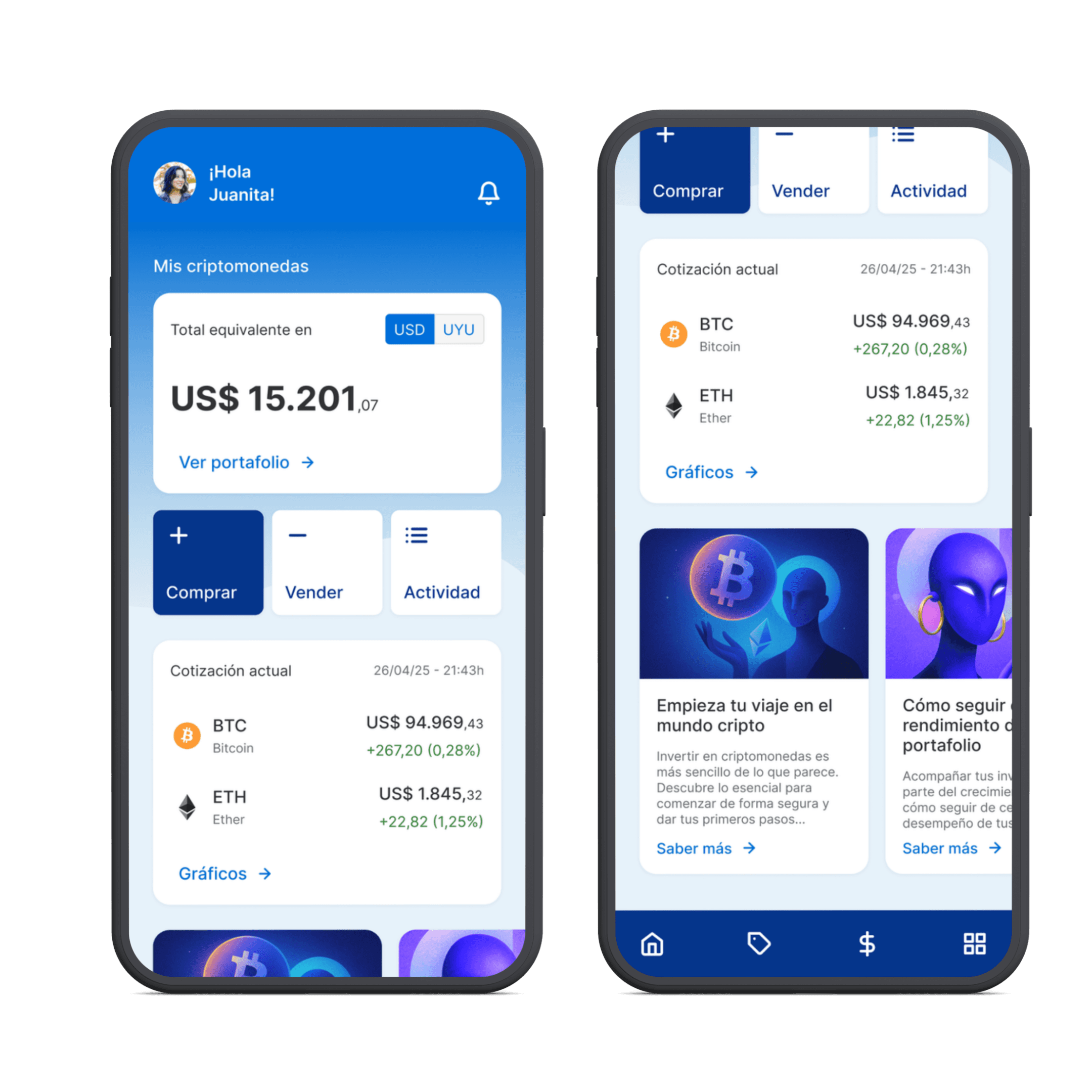
Simplicity first
• Clear portfolio view instead of a trading cockpit.
• Dual-currency display (USD / UYU) with one-tap switching.
• Contextual tips and risk messages embedded in the home and cards, instead of a separate “education section”.
Lean, focused MVP
• Three core actions only: buy, sell and track performance.
• MVP limited to Bitcoin and Ethereum, reinforcing focus and clarity for beginners.
• Values always shown in local currency + crypto, encouraging small, safe first tickets.
Simplicity first
• Clear portfolio view instead of a trading cockpit.
• Dual-currency display (USD / UYU) with one-tap switching.
• Contextual tips and risk messages embedded in the home and cards, instead of a separate “education section”.
Lean, focused MVP
• Three core actions only: buy, sell and track performance.
• MVP limited to Bitcoin and Ethereum, reinforcing focus and clarity for beginners.
• Values always shown in local currency + crypto, encouraging small, safe first tickets.
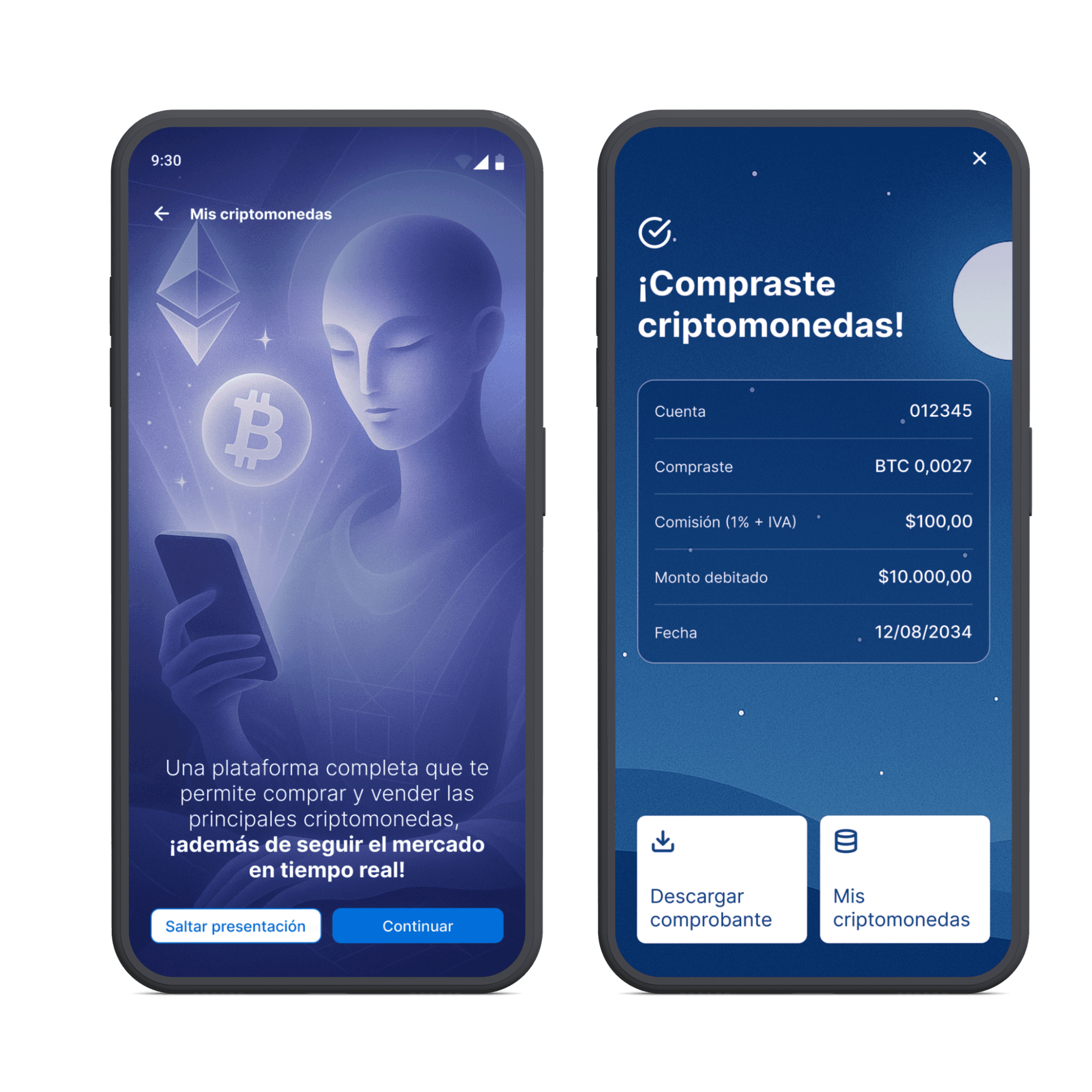
Guided onboarding for first-time buyers
• Step-by-step flow that explains each action before users commit.
• Progressive education instead of a long tutorial upfront.
Familiar, on-brand visual language
• Crypto hub mirrors the same layout structure as the OCA Blue home, reinforcing familiarity.
• Colors, typography and components follow the existing design system to feel like “OCA”, not a separate app.
Note: Illustrations in this case study are representational, not the official production assets.
Guided onboarding for first-time buyers
• Step-by-step flow that explains each action before users commit.
• Progressive education instead of a long tutorial upfront.
Familiar, on-brand visual language
• Crypto hub mirrors the same layout structure as the OCA Blue home, reinforcing familiarity.
• Colors, typography and components follow the existing design system to feel like “OCA”, not a separate app.
Note: Illustrations in this case study are representational, not the official production assets.
Contextual walkthrough, not a generic tutorial
• On first use, key parts of the crypto hub are explained with in-flow walkthrough cards.
• Each step focuses on a single decision (seeing your portfolio, choosing how much to invest, confirming).
• Copy is written in plain, local language to reduce fear and reinforce control (“you can always start small”).
Contextual walkthrough, not a generic tutorial
• On first use, key parts of the crypto hub are explained with in-flow walkthrough cards.
• Each step focuses on a single decision (seeing your portfolio, choosing how much to invest, confirming).
• Copy is written in plain, local language to reduce fear and reinforce control (“you can always start small”).
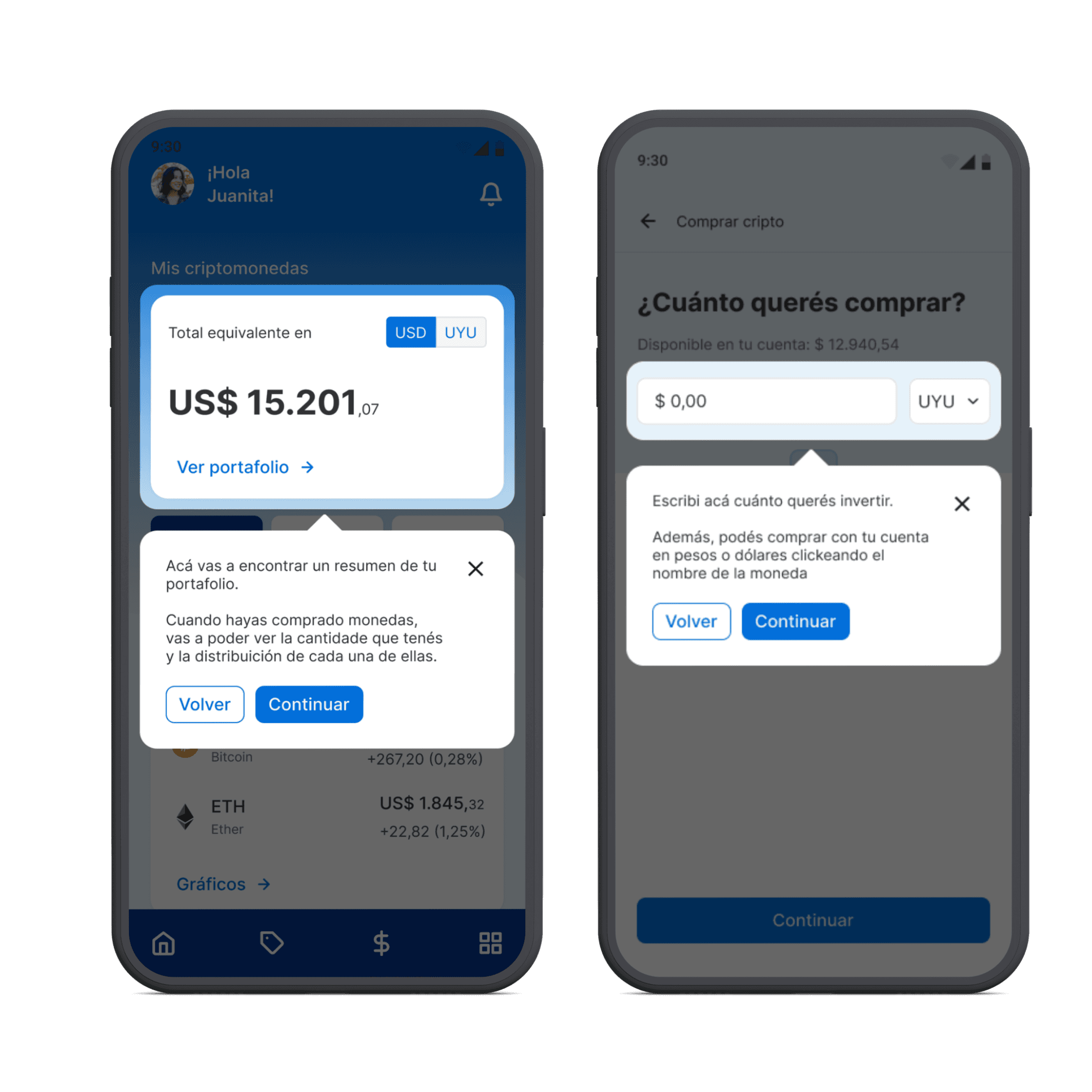
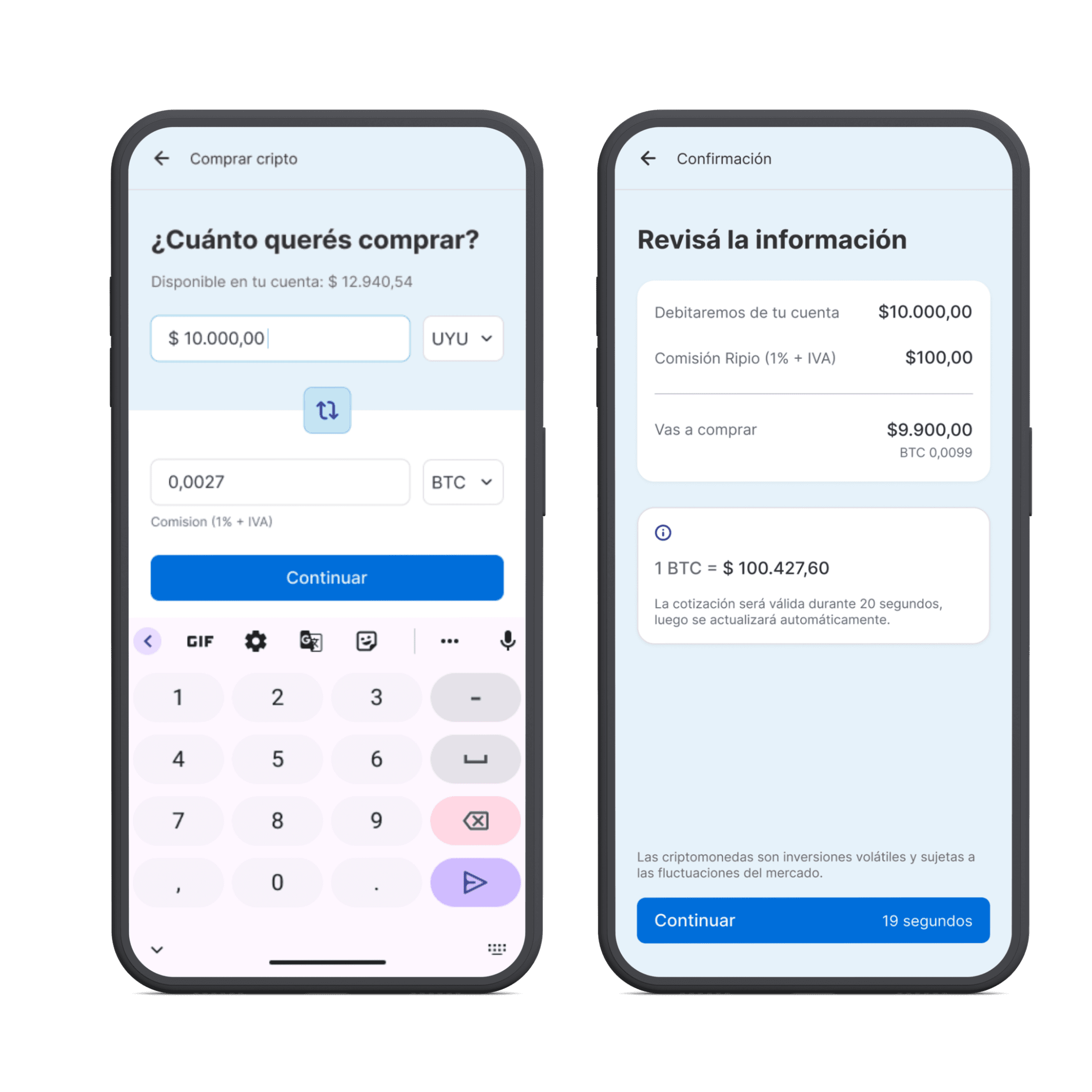
Money-first input, with clear conversion
• Usability tests showed that most beginners think in pesos or dollars, not in fractions of BTC/ETH, so I inverted the original flow: the primary input is now the money amount, and the crypto amount is calculated automatically below.
• A switch lets users invert the logic (type in crypto and see the equivalent in UYU/USD), keeping control for more confident users.
• Currency (pesos or dollars) can be changed on the same screen, so people don’t need to leave the flow to adjust it.
Calmer confirmation, with a short price lock
• The review screen breaks down exactly what will be debited, the fee and the final crypto amount.
• A 20-second price lock guarantees the quoted rate while the user reads and decides, reducing anxiety in a volatile market.
Money-first input, with clear conversion
• Usability tests showed that most beginners think in pesos or dollars, not in fractions of BTC/ETH, so I inverted the original flow: the primary input is now the money amount, and the crypto amount is calculated automatically below.
• A switch lets users invert the logic (type in crypto and see the equivalent in UYU/USD), keeping control for more confident users.
• Currency (pesos or dollars) can be changed on the same screen, so people don’t need to leave the flow to adjust it.
Calmer confirmation, with a short price lock
• The review screen breaks down exactly what will be debited, the fee and the final crypto amount.
• A 20-second price lock guarantees the quoted rate while the user reads and decides, reducing anxiety in a volatile market.

Impacts & Results
Impacts & Results
We moved from curiosity and hesitation to a trusted, in-app crypto experience with strong validation from users and leadership.
User validation
100% task success in usability tests (9 participants)
4.8/5 average satisfaction across main flows
0% drop-off during testing and consistent praise for the in-flow education
Business & strategic impact
First traditional bank in Uruguay to offer integrated crypto services for a base of 350k+ OCA Blue clients
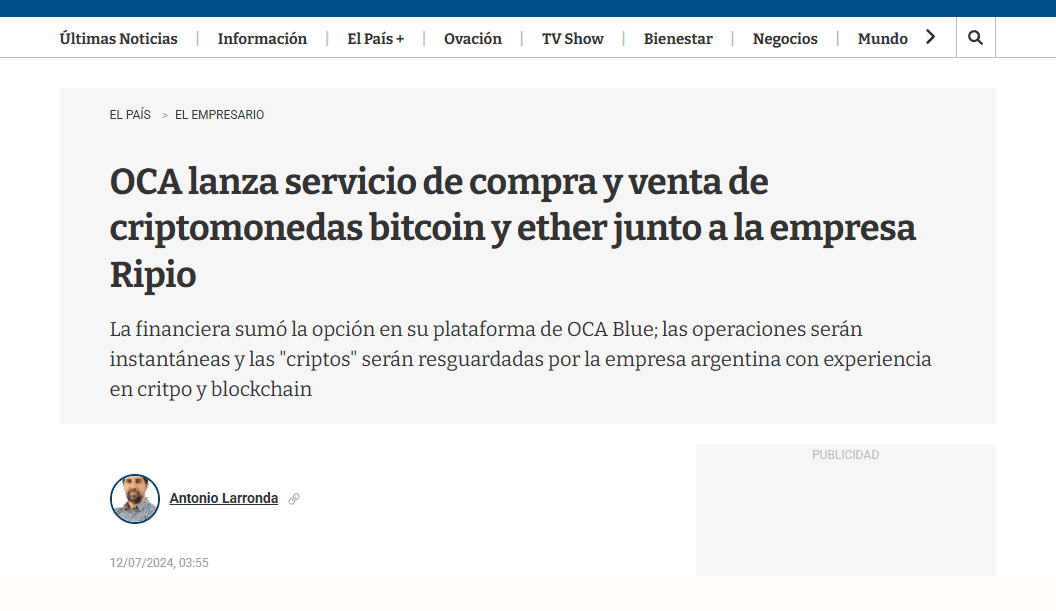
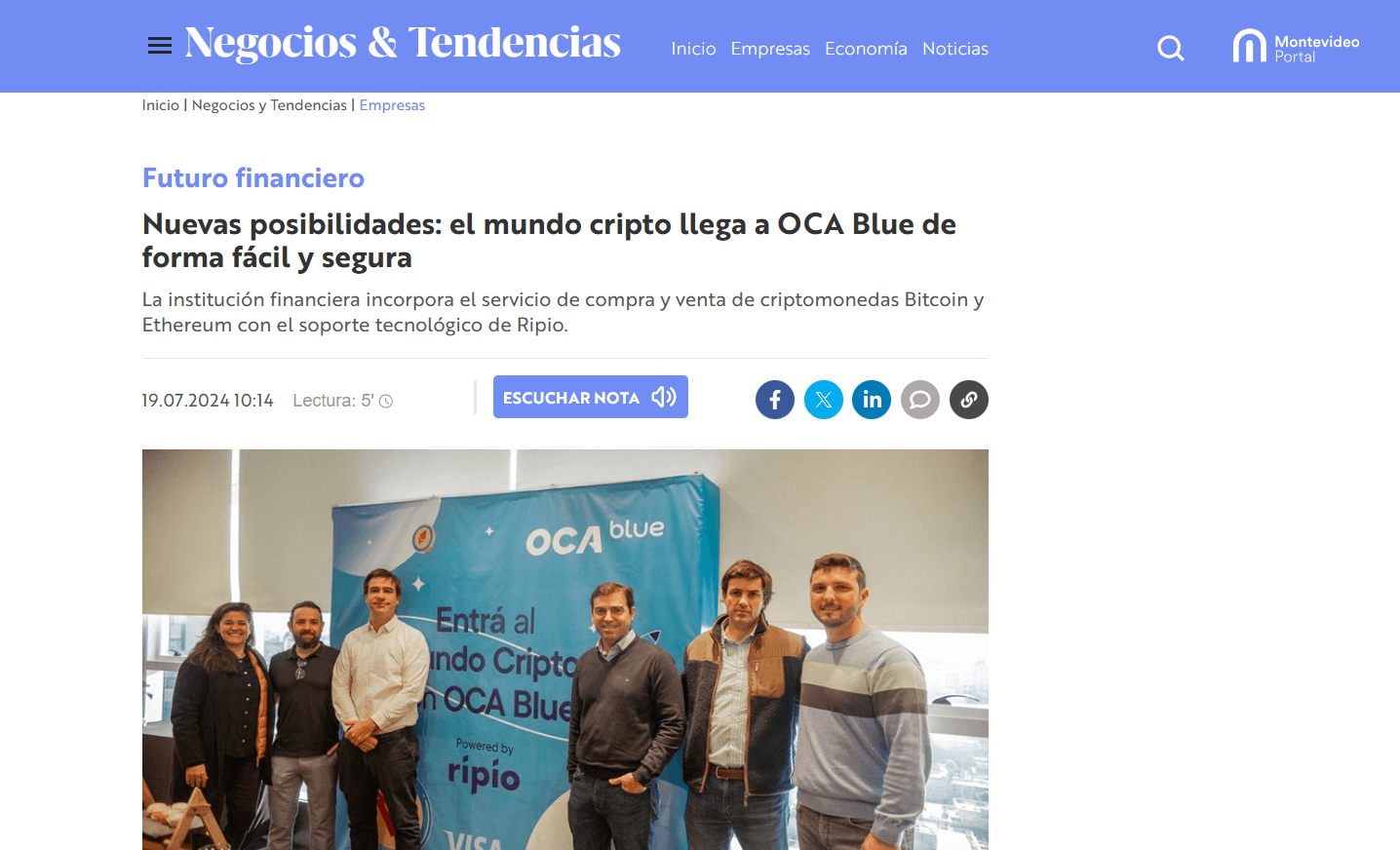
MVP approved by the CEO and executive team, later highlighted in local media as a controlled, education-first way to access crypto
Positioned as Itaú’s first crypto implementation outside Brazil, serving as a pilot for future Latin American initiatives
Post-launch performance (early data)
In an interview about the first weeks after launch, OCA’s CEO Pedro Moreira explained that, although crypto is not yet a mass product, the team was already seeing 150%+ growth in crypto transactions compared to the pre-launch baseline, when clients had to buy crypto on external platforms using their OCA card. This confirmed there was a real, previously “invisible” demand once the journey was brought inside a trusted banking environment.
From the partner side, Martín Benítez from Ripio (OCA’s crypto infrastructure provider, operating in multiple Latin American markets) highlighted that in just the first two weeks, average purchase volume per client was almost 2x higher than in other countries, with a “very strong” conversion rate. This external benchmark reinforced that the education-first approach was not only compliant and safe, but also commercially effective.
I also travelled to Montevideo for in-person prototype tests, which helped refine language and nuances that wouldn’t appear in remote sessions alone.
We moved from curiosity and hesitation to a trusted, in-app crypto experience with strong validation from users and leadership.
User validation
100% task success in usability tests (9 participants)
4.8/5 average satisfaction across main flows
0% drop-off during testing and consistent praise for the in-flow education
Business & strategic impact
First traditional bank in Uruguay to offer integrated crypto services for a base of 350k+ OCA Blue clients
MVP approved by the CEO and executive team, later highlighted in local media as a controlled, education-first way to access crypto
Positioned as Itaú’s first crypto implementation outside Brazil, serving as a pilot for future Latin American initiatives
Post-launch performance (early data)
In an interview about the first weeks after launch, OCA’s CEO Pedro Moreira explained that, although crypto is not yet a mass product, the team was already seeing 150%+ growth in crypto transactions compared to the pre-launch baseline, when clients had to buy crypto on external platforms using their OCA card. This confirmed there was a real, previously “invisible” demand once the journey was brought inside a trusted banking environment.
From the partner side, Martín Benítez from Ripio (OCA’s crypto infrastructure provider, operating in multiple Latin American markets) highlighted that in just the first two weeks, average purchase volume per client was almost 2x higher than in other countries, with a “very strong” conversion rate. This external benchmark reinforced that the education-first approach was not only compliant and safe, but also commercially effective.
I also travelled to Montevideo for in-person prototype tests, which helped refine language and nuances that wouldn’t appear in remote sessions alone.

What I learned
This project reminded me that good research doesn’t just support a roadmap, it can rewrite it, shifting a crypto product from “more features” to a strategy grounded in trust and education. It also reinforced how critical it is to design for emotional barriers (fear, confidence, safety), especially in regulated financial products, and to communicate those decisions clearly across countries and teams.
This case was completed before I started using AI in my workflow. Today, I use large language models to speed up research synthesis and hypothesis generation, skills I now bring to similar complex, regulated projects.
What I learned
This project reminded me that good research doesn’t just support a roadmap, it can rewrite it, shifting a crypto product from “more features” to a strategy grounded in trust and education. It also reinforced how critical it is to design for emotional barriers (fear, confidence, safety), especially in regulated financial products, and to communicate those decisions clearly across countries and teams.
This case was completed before I started using AI in my workflow. Today, I use large language models to speed up research synthesis and hypothesis generation, skills I now bring to similar complex, regulated projects.
Let's work together
Open to the right remote opportunities. If you're building something complex and need a designer who can hold the full picture, let's talk.

Let's work together
I'm currently open to remote design opportunities, whether freelance, contract, or full-time. I help teams build high-impact digital products through a mix of strategy, design, and user research, with a strong focus on usability, clarity, and business alignment.
Ready to explore a project together?